

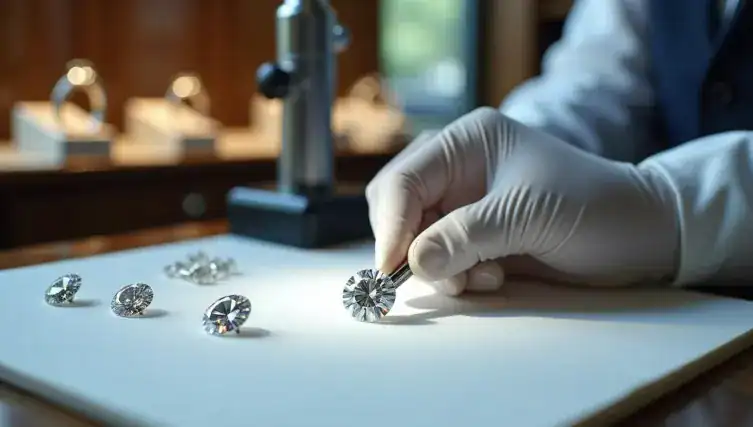
Did you know that a Flawless clarity grade is achieved by just a tiny percentage of diamonds? My experience as a Buffalo jeweler has taught me that understanding the 4Cs can make your diamond shopping truly exceptional.
The 4Cs—cut, clarity, color, and carat weight—are the foundations of diamond quality assessment. The Gemological Institute of America (GIA) created this standardized grading system. GIA founder Robert M. Shipley coined this universally recognized system back in the 1940s to help students grasp the four key factors that define a faceted diamond. These four characteristics determine both the beauty and value of your diamond as you browse Buffalo jewelry stores.
Beautiful diamond options abound in Buffalo stores, but knowing what to look for is crucial. The most popular choice, a round brilliant diamond, features 58 facets that create maximum light reflection. The carat weight often draws the most attention, with one carat equal to 200 milligrams or one-fifth of a gram. As your trusted Buffalo NY jeweler, I’m here to direct you through these choices and find that perfect balance between your vision and budget.
This piece takes a deep dive into each of the 4Cs, helping you focus on what matters most for your perfect diamond. Buffalo jewelers offer the expertise you need to make an informed decision, whether you’re selecting an engagement ring or a special gift.
Start with What Matters Most to You
Your diamond priorities should be the first thing to nail down when shopping for a diamond. As your Buffalo jeweler, I know that understanding what you value most will help you find the perfect diamond.
Finding your ideal diamond starts with a simple question: what do you value most? Each of the 4Cs adds something unique to a diamond’s appeal, but their importance changes based on your taste. Understanding the 4Cs and asking yourself “Which C matters most to me?” will help you focus on diamonds that match your priorities.
Do you want size, sparkle, or clarity?
This is the first big question most diamond shoppers face. Your answer will shape every choice that follows.
If size is your priority:
- Think about fancy shapes like oval, marquise, or emerald that look larger than round diamonds of equal carat weight
- Note that carat measures weight, not size – a 1-carat diamond is 200 milligrams
- Prices jump sharply as carat weight goes up
- A poor cut can make a large diamond look smaller than it should
If sparkle fascinates you:
- Put cut quality first
- Look for excellent or ideal cut grades
- See how the diamond looks under different lights
- About 67% of customers pick an ideal cut to get maximum sparkle
If clarity is your thing:
- Step-cut shapes (emerald, asscher) need higher clarity grades because their facets make inclusions easier to spot
- Brilliant cuts let you choose lower clarity grades since they hide inclusions better
- Most SI grade diamonds have flaws you can’t see without magnification
- The location of inclusions matters more than the grade itself
Buffalo jewelry shoppers often focus on size alone, but experienced jewelers know that finding the right balance creates the best results. The shape you pick also changes what matters most – round brilliants maximize sparkle, emerald cuts showcase clarity, and fancy shapes can make diamonds look bigger.
How to set your diamond priorities
Setting priorities means balancing what you want, what you can spend, and what trade-offs make sense. Here’s how I guide my clients at our Buffalo jewelry store:
- Identify your non-negotiables
What must your diamond have? A minimum size? Perfect clarity? Maximum sparkle? Your must-haves will narrow down your options fast.
- Rank the remaining characteristics
After your must-haves, rank everything else by importance. This makes comparing diamonds much easier.
- Determine your budget boundaries
Your budget shows where you might need to compromise. Priorities help you spend money on what matters most.
- Consider how characteristics interact
Diamond characteristics work together. For example:
- A well-cut diamond sparkles so bright you can see it from across the room
- Brilliant cuts hide color and inclusions better than step cuts
- Great cut quality can make a lower-color diamond shine brighter
- Visualize the diamond in its setting
Your choice of setting changes how diamond features look. Some settings can hide small flaws or make diamonds look bigger.
My years as a Buffalo NY jeweler have shown me that clients who start focused only on carat weight often realize other factors make a bigger difference in a diamond’s beauty. Taking time to set clear priorities leads to better purchases and value.
Why cut is often the best place to invest
Cut quality deserves special attention because it shapes a diamond’s visual appeal more than anything else. Here’s why diamond experts, including our Buffalo jewelers, say cut quality should top your list:
Cut is the human factor
Nature determines other characteristics, but cut quality comes from human skill. It’s the only value factor that depends on craftsmanship. This vital aspect might be technical but makes all the difference in your buying decision.
Cut determines light performance
Cut quality controls how a diamond plays with light, affecting its:
- Brightness (brilliance): How white light reflects inside and out
- Fire: How light breaks into rainbow colors
- Scintillation: The light and dark patterns and sparkle when moved
Cut can compensate for other characteristics
Great cut quality can improve diamonds with lower color or clarity:
- A well-cut diamond can look bright and white despite slight color
- Brilliant cuts hide flaws that step cuts would show
- Superior cut can make smaller diamonds look more impressive
Cut quality affects long-term value
Excellent or ideal cut diamonds keep their value better. Round brilliant cuts hold the best resale value because they’re popular and brilliant.
Industry experts agree on cut priority
Diamond experts keep saying cut matters most. The Gemological Institute of America (GIA) puts it simply: “A diamond’s appeal depends more on cut than anything else”.
A poor cut wastes potential
Even flawless, colorless diamonds with perfect clarity look dull with poor cuts. A well-cut diamond will always look better and be worth more than one with compromised cut quality.
These reasons drive me to tell my Buffalo jewelry store clients never to skimp on cut quality. If money’s tight, it’s better to pick a slightly smaller diamond with excellent cut than a bigger one that’s poorly cut. The difference jumps right out at you.
We let clients compare diamonds with different cut grades side by side in our store. This shows why investing in cut quality gives you the most noticeable return in beauty and brilliance. Buffalo jewelers like me can help you balance cut quality with other features within your budget.
A diamond’s beauty comes from how it handles light. Even perfect raw material needs proper cutting to shine its brightest. Putting cut quality first ensures you’ll get the most stunning diamond your budget allows.
Cut and Color: The Visual Impact Duo
The magic of a diamond’s beauty comes from how it plays with light. As a Buffalo jeweler, I’ve watched countless customers get drawn to a diamond’s sparkle before anything else. This visual appeal stems from the fascinating relationship between two key features: cut and color.
These two characteristics work together to create what we notice as a diamond’s beauty. While carat weight determines size and clarity affects transparency, cut and color control how a diamond handles light—this is what makes diamonds so captivating.
How cut brings out the diamond’s sparkle
A diamond’s cut truly showcases craftsmanship. Nature determines other diamond characteristics, but cut quality depends on human skill and precision. At our Buffalo jewelry store, I always highlight how cut quality directly shapes a diamond’s interaction with light.
A diamond’s sparkle shows three distinct optical effects:
- Brightness (Brilliance): The internal and external reflection of white light
- Fire: The scattering of white light into rainbow colors
- Scintillation: The sparkle that emerges as you move the diamond, creating patterns of light and dark
The science behind this sparkle amazes me. Light enters a diamond, then refracts, reflects, and disperses. A skillfully cut diamond bounces light from facet to facet before returning it to your eye, creating that unmistakable brilliance.
Many Buffalo jewelry shoppers don’t realize that even a flawless, colorless diamond with perfect clarity looks dull with a poor cut. The proportions need precision—a diamond cut too shallow lets light escape from the bottom; too deep, and light escapes from the sides. Both scenarios rob the diamond of its potential brilliance.
Each facet’s angles and locations determine how light travels through the stone. I’ve shown many clients the striking difference between diamonds with different cut grades. An excellent cut diamond shows exceptional brilliance because light enters, bounces around inside, and exits mainly through the diamond’s top.
GIA’s diamond experts have proven that many proportion combinations maximize brilliance and fire in round brilliant cut diamonds. All the same, higher cut grades generally mean brighter diamonds.
Clarity and Carat: The Hidden Details
A fascinating world of microscopic features lies behind every diamond’s sparkle – features most buyers never see. I’ve guided countless clients through clarity and carat as a Buffalo jeweler. These two characteristics raise the most questions but also give you the best chances to shop smart for diamonds.
Clarity and Carat: The Hidden Details
What clarity grades really mean
The GIA Clarity Scale goes beyond simple “flawless” or “included” classifications. It uses 11 distinct grades to show how free a diamond is from blemishes and inclusions. Jewelers worldwide use this standardized language to communicate diamond quality.
The clarity scale runs from Flawless (FL) to Included (I3), with each grade showing specific features at 10x magnification:
- Flawless (FL): No inclusions or blemishes visible under 10x magnification
- Internally Flawless (IF): No inclusions visible, just minor surface blemishes
- Very, Very Slightly Included (VVS1 & VVS2): Tiny inclusions that even skilled graders struggle to see
- Very Slightly Included (VS1 & VS2): Minor inclusions you can spot with effort
- Slightly Included (SI1 & SI2): Noticeable inclusions
- Included (I1, I2 & I3): Clear inclusions that might affect transparency and brilliance
Clarity grading looks at more than just flaws. At our Buffalo jewelry store, we look at five key factors: size, nature, number, location, and relief (contrast) of each feature. An inclusion’s position makes a big difference in visibility – you’ll notice them more under the table (top) than near the girdle (edge).
When inclusions matter (and when they don’t)
Buffalo jewelry shoppers often think they need the highest clarity grade. All the same, this isn’t always needed or the best way to spend your budget.
You can’t see most inclusions in gem-quality diamonds without magnification. This creates a sweet spot: diamonds with inclusions visible only under magnification offer great value without losing any beauty.
Here’s when inclusions become important:
Inclusions typically matter when:
- You can easily see them without magnification
- They reduce the diamond’s brilliance or make it look hazy
- They might cause structural issues (especially with surface-breaking inclusions)
- You pick a step-cut diamond (emerald or asscher cut) with large open facets
- Your diamond is larger, making inclusions more obvious
Inclusions typically don’t matter when:
- You need magnification to see them
- They sit away from the diamond’s center
- You choose a brilliant-cut diamond that naturally hides inclusions
- Your diamond is smaller (under 1 carat)
Buffalo jewelers find the best clarity value in VS1, VS2, and SI1 grades. These grades are durable and cost much less than higher grades.
Some inclusion types need more attention than others. Small feathers (tiny fractures) rarely cause problems, but larger inclusions like cavities, chips, and etch channels might affect durability or trap dirt. As your Buffalo jeweler, I’ll help you spot which inclusions could affect your diamond’s performance over time.
The concept of “eye-clean” matters more than the technical grade. Your diamond will look flawless in daily wear if you can’t see inclusions without magnification—no matter what the certificate says.
Carat weight vs. perceived size
My clients often mix up carat weight and size. Carat measures weight, not size.
A carat equals 0.2 grams or 200 milligrams. This tiny weight unit shows how precious diamonds are—a small paperclip weighs about one carat.
Your diamond’s visible size doesn’t grow evenly with its carat weight. A 2-carat diamond looks only 23% larger than a 1-carat diamond, even though it weighs twice as much. A well-cut 1-carat round diamond usually measures about 6.5mm across, while a 2-carat diamond measures around 8.0mm.
Several things affect how big a diamond looks beyond its weight:
Cut quality: Well-cut diamonds return more light and look larger than poorly-cut ones of the same weight. Extra weight hidden in deep cuts or thick girdles adds nothing to visible size.
Shape choice: Some shapes look bigger than others at the same weight. Oval, pear, and emerald cuts usually appear larger from above than round diamonds weighing the same.
Setting design: We can create settings that make your diamond look bigger through halos, metal colors, and prong placement.
This explains why similar-looking diamonds can have very different prices. Rarity, weight and value grow exponentially, not linearly. A 2-carat diamond costs more than two 1-carat diamonds of similar quality because nature produces fewer large diamonds.
Buffalo Jeweler Tips for Smart Diamond Shopping
Proper certification gives you confidence when shopping for diamonds. A beautiful diamond means nothing without verification of its authenticity and quality. My years as a Buffalo jeweler have taught me how to guide clients through diamond selection. A few key strategies can make your shopping experience much better.
Why certification matters (GIA, IGI, etc.)
Diamond certification gives you a detailed analysis of a stone’s attributes. This includes cut, color, clarity, and carat weight – details you need to make smart purchase decisions. The Gemological Institute of America (GIA) and International Gemological Institute (IGI) stand out as the most respected certification bodies.
GIA, 92 years old, remains the gold standard for diamond certification. This nonprofit organization pioneered the 4Cs grading system that the industry uses worldwide. Multiple gemologists check each diamond through a rigorous process to ensure accurate, consistent results.
IGI started in 1975 and certifies both natural and lab-grown diamonds. Buffalo jewelers respect IGI but know their grading standards tend to be more lenient than GIA’s. Diamonds often receive higher grades from IGI compared to GIA’s stricter standards.
Your diamond should always come with a grading report from an independent, accredited lab. This documentation proves your diamond’s value, quality, and authenticity. Diamonds priced over $2,000 absolutely need proper certification – don’t buy one without it.
How to compare diamonds in-store
The right viewing conditions make a huge difference when comparing diamonds at Buffalo jewelry stores. You should see diamonds under different lights – not just the specialized jewelry store spotlights that make every diamond sparkle. Natural light near windows or standard office lighting gives you a better view.
Direct comparisons work better than looking at stones one after another. People can’t reliably remember sparkle and brilliance, so compare diamonds side by side. Watch how diamonds perform as you move them to see their scintillation patterns.
Loose diamonds (unset) show you the whole picture, especially with a magnifier. Settings can hide flaws under prongs and affect how you see the color. This simple check prevents buyer’s remorse later.
Questions to ask your Buffalo NY jeweler
The right questions help you get the best value and satisfaction:
- “Can I see different diamonds to compare?” This shows you options in your price range.
- “How does this diamond rate on the 4Cs?” Good Buffalo NY jewelers explain each feature clearly.
- “Does a grading report come with this diamond?” Always check certification first.
- “What protection options do I have?” Learn about appraisal and insurance.
- “What makes this diamond better than others at this price?” This tests the jeweler’s expertise and honesty.
- “How does the cut affect light performance?” This reveals the jeweler’s technical knowledge.
Good jewelers welcome questions openly. A jeweler who hesitates to answer should raise red flags. Book Your Jewelry Consultation with a Buffalo jeweler who values education and transparency.
Using online tools to preview diamonds
Diamond shopping has changed thanks to online visualization tools. These tools let you study diamonds in detail before visiting stores. To name just one example, see Blue Nile’s diamond visualization tool with 360-degree magnified HD videos that show cut grade, brilliance, clarity, and color depth.
These tools help you find diamonds matching your criteria with detailed images. You’ll make better use of store visits because you’ll know what to look for. For example, DiamDB helps you picture different carat weights on a finger.
Online research before visiting your Buffalo jewelry store builds your knowledge. Your local jeweler can then help evaluate specific diamonds you found online.
Why local buffalo jewelers can offer better guidance
Local Buffalo jewelers give you advantages that online shopping can’t match. Buying from a local jeweler starts a relationship that goes beyond just one purchase. This connection helps with future cleanings, repairs, and maintenance.
Buffalo jewelers know their products better than online support teams. Local jewelers solve problems faster than website support. Your Buffalo NY jeweler also gives personal recommendations based on your style, budget, and priorities.
Local purchases strengthen our economy. Local jewelry stores keep 65-70% of every $100 spent in the local economy, while retail chains only keep 45%.
Smart shoppers combine online research with local expertise. Research helps you understand options and prices. Your Buffalo jeweler provides personal guidance, real comparisons, and a valuable long-term relationship.
Conclusion
The perfect diamond selection boils down to balancing personal priorities with smart shopping strategies. My years as a Buffalo jeweler have shown me how customers find their ideal diamond after learning about the 4Cs. This knowledge enables you to make confident decisions that match your esthetic desires and budget constraints.
Cut quality stands as the life-blood of diamond beauty. A well-cut stone turns light into magical sparkle that engages you instantly. This characteristic gives you the best return on investment. The way cut works with color lets you make smart trade-offs to maximize visual impact without spending more than needed.
Smart buyers can find great value in clarity and carat weight. Eye-clean diamonds with technical inclusions you can only see under magnification often cost much less. You can also save big by picking diamonds just below magic weight thresholds (0.92ct instead of 1.00ct) with almost no visible size difference.
Your own eyes should be the final judge. The way a diamond speaks to you goes beyond what any technical grading or certification can describe. GIA certification provides essential verification, but your personal reaction matters most.
Local Buffalo jewelers give you personalized guidance that websites just can’t match. We help direct complex decisions, show side-by-side comparisons, and share expertise from years of hands-on experience. Our relationship goes beyond your first purchase – we’re here to support your jewelry needs through cleaning, maintenance, and future purchases.
Your perfect diamond is waiting. The 4Cs knowledge, personal priorities, and practical shopping strategies will help you find a diamond that goes beyond your expectations. The diamond you choose will likely represent something meaningful—love, achievement, or celebration. Finding the right mix of beauty, quality, and value makes the experience even more special.
Key Takeaways
Master the art of diamond selection by understanding how the 4Cs work together to create beauty and value, with expert insights from Buffalo jewelers to guide your perfect purchase.
• Prioritize cut quality above all else – Cut determines sparkle and brilliance more than any other factor, making even lower-grade diamonds appear stunning when expertly cut.
• Target diamonds just under “magic weights” – A 0.92-carat diamond costs significantly less than 1.00-carat while appearing virtually identical, maximizing your budget.
• Focus on “eye-clean” clarity over technical grades – SI1-VS2 diamonds often appear flawless without magnification, offering excellent value without visible compromise.
• Use cut quality to offset lower color grades – An excellent-cut G-color diamond typically appears more beautiful than a poorly-cut F-color stone at lower cost.
• Always demand proper certification from GIA or IGI – Independent grading reports ensure authenticity and accurate quality assessment for informed purchasing decisions.
The key to smart diamond shopping lies in understanding that technical grades don’t always translate to visible beauty. By balancing the 4Cs strategically and working with knowledgeable local jewelers, you can find a diamond that maximizes both visual impact and value within your budget.
FAQs
Q1. What is the most important factor to consider when choosing a diamond?
Cut is generally considered the most crucial of the 4Cs as it has the greatest impact on a diamond’s brilliance and overall appearance. A well-cut diamond can make lower color or clarity grades appear more beautiful.
Q2. How can I get the best value when buying a diamond?
To maximize value, consider diamonds just under “magic weights” (e.g., 0.92 carats instead of 1 carat), focus on “eye-clean” clarity rather than flawless grades, and prioritize excellent cut quality which can offset lower color grades.
Q3. Why is diamond certification important?
Certification from reputable labs like GIA or IGI provides an independent, detailed analysis of a diamond’s attributes, ensuring its authenticity and quality. It’s essential for making informed decisions, especially for diamonds over $2,000.
Q4. How do the 4Cs (cut, color, clarity, and carat) interact with each other?
The 4Cs work together to determine a diamond’s overall beauty and value. For example, an excellent cut can make a diamond with lower color grade appear brighter, while larger carat weights may require higher clarity grades to appear eye-clean.
Q5. What advantages do local jewelers offer over online diamond shopping?
Local jewelers provide personalized guidance, allow for side-by-side comparisons, offer expertise from years of experience, and establish ongoing relationships for future maintenance and purchases. They can also provide tailored recommendations based on your style and preferences.

